Showing posts with label julie ann brady. Show all posts

Monday, December 16, 2019

Yellow Mandevilla Host Plant of Oleander Caterpillar

If you build it, they will come! If you plant it, they will come. I'm talking about my experience with the beautiful yellow mandevilla vining plant and the oleander caterpillar. Years ago, in my Jacksonville, Florida backyard garden, I planted several oleanders. As they began to mature into beautiful leafy little tree-like plants, I witnessed an invasion of the oleander caterpillar. At that time, I didn't realize how beautiful the adult stage of this caterpillar would be and decided to totally remove all the oleander.

Julie's Garden Nature Walk - Oleander Caterpillar on Yellow Mandevilla
In 2017, I spotted a yellow flowering vine-plant at Home Depot and decided to buy it for my front yard garden in my Leesburg, Florida senior park home. The first several months of the yellow mandevilla, everything seemed pretty normal with it growing and maturing with pretty yellow trumpet-like flowers.

Flowering Yellow Mandevilla in Leesburg Florida
As the Yellow Mandevilla continued to grow, I installed a tall metal trellis to support the vines. It is a plant of the genus Allamanda in the dogbane family of Apocynaceae.

Flowering Yellow Mandevilla and Other Plants in Leesburg Florida Garden
It was probably in early 2018 that I began to see the oleander caterpillars appearing on my Yellow Mandevilla. At first, there were only a couple, but it seemed that they began to multiply soon afterwards. Like, the word was out!

Polka Dot Wasp Moth on Confederate Star Jasmine
It was November 29, 2016, that I photographed my first Polka Dot Wasp Moth. It was found buzzing my Confederate Star Jasmine, another vine-like plant on a trellis in my front yard garden in Leesburg, Florida.

Polka Dot Wasp Moth Flying
It would be not quite two years later that I would realize that this beautiful, unique moth started off as the Oleander Caterpillar! For that reason, I allowed probably hundreds of Oleander Caterpillars to obliterate my pretty Yellow Mandevilla as they progressed to adulthood as the Polka Dot Wasp Moth!

Oleander Caterpillar Eating my Yellow Mandevilla
For more than two years, I watched my Yellow Mandevilla become the host plant to hundreds of Oleander Caterpillars.

Oleander Caterpillar Poop From Eating My Yellow Mandevilla
In November 2019, I watched a thriving, healthy Yellow Mandevilla taken literally to the ground by the Oleander Caterpillar. That was when I decided I wouldn't let the plant come back for another season.

My Front Yard Garden in Leesburg Florida - Yellow Mandevilla on Right
I've written another blog post about the Polka Dot Wasp Moth. It is truly a marvel of Mother Nature and definitely my favorite such moth. To experience such a beautiful creature, it is worthy of the experience with growing a Yellow Mandevilla host plant! I'm so happy I had this experience and would recommend it to you.

A great resource for wonderful photos and interesting information on the Oleander Caterpillar is hosted by the University of Florida.

Wednesday, October 03, 2018

Pink Powder Puff Calliandra surinamensis

The Pink Powder Puff is one of the most interesting plant-tree! Taking a look at the Pink Powder Puff growing in my front yard garden, you're not sure what it actually is. Is it a dwarf-tree, or a plant, or a shrub?

Pink Powder Puff Calliandra surinamensis
Pink Powder Puff Calliandra surinamensis - August 27, 2018 PM
I am fairly confident that this type of mimosa is the Calliandra surinamensis of the Family: Fabaceae and Subfamily: Mimosoideae. It is also known as Surinam Powder Puff, Pink Powder Puff, Pompon De Marin, Surinamese Stickpea, and Officiers-kwast. It originates in the country of Suriname, in northern South America.

Pink Powder Puff Calliandra surinamensis
Pink Powder Puff Calliandra surinamensis - November 14, 2017
My Pink Powder Puff is now about one year old. The first couple of months, into cold weather, the plant did not achieve the look you see in the first photo above. It was approaching one year of age before it started to look like a dwarf-tree with quite the canopy. Right from the early age, it did have plenty of powder puffs but I don't believe I ever saw the bean-like seed pods until September 2018.

Close-up view of the Pink Powder Puff
Close-up view of the Pink Powder Puff - July 2, 2018
It was the month of September 2018 when I began to see what looked like bean pods sprouting all over my pink powder puff. Some had turned brown and opened. I decided to clip them off, dry them, and harvest the seeds.

Drying Seed Pods of Pink Powder Puff
Drying Seed Pods of Pink Powder Puff - October 2, 2018
Once you start clipping those pods, you realize just how many there are. I originally had only a few that I put on top of a bin in the shed. I couldn't understand a couple of days later why they were lying on the floor of the shed. Then I put the lot of them on a tray on top of the washer ... come back a day or so to find several out of the tray, on the washer, and on the ground.

Opened Seed Pod of the Pink Powder Puff
Opened Seed Pod of the Pink Powder Puff - October 2, 2018
I was standing outside the shed and could actually hear them POP when they opened up and again they were not in the tray. Just like the Mexican jumping bean!!!

Seeds from the Pink Powder Puff
Seeds from the Pink Powder Puff - October 2, 2018
October 3, 2018, it was late in the afternoon, around 5:30pm. I was out in the shed going through the seed pods to pull out those that opened and didn't yet release the seeds and picking up the loose seeds. All of a sudden, I heard a very loud SNAP!!! as one opened up, flew up in the air, hit the side of my left hand little finger and then flew on the ground next to the washer. I have never heard of such a thing ... it was kind of a violent action ... and very very strange. I rather suspected something like that after finding these all askew in the shed and then hearing something yesterday about this time as I was standing just outside the shed with the door shut. Like, WHO KNEW???

October 4, 2018 around 3pm in the afternoon ... I was out checking on how many seed pods had opened ... quite a few ... when they started ferociously SNAPPING. I lost a few that escaped from under the netting and flew off to my left into the shed. I sincerely think these are SNAP PEAS!!

Researching the seeds, I found a reference that tells you how to prepare the seeds for best use. It seems you need to scar them ... one recommendation was with sand paper. So, I think I will grab my emery boards and go to it before I try planting these.

Scarified Seeds from the Pink Powder Puff
Scarified Seeds from the Pink Powder Puff - October 3, 2018
I found a bit of information on how the powder puff seeds should be prepared for planting. Although my variety is not the strigillosa, I believe this information is still applicable.
"Scarify and inoculate seed with strophostyles spec.1 before planting. Scarifying (nicking or roughing the seed coat) seed greatly improves germination, and establishment time after planting. Walker (2005) found that mechanically scarified seed ranged in germination from 74 to 85 percent. Pitman (2009) used sandpaper to scarify powderpuff seed and had similar results. The average percent germination of unscarified seed was 14 while the scarified was 96. In both experiments, physically roughing the seed coat resulted in better seed germination than unscarified, chemical or heat treatments. If scarified seed is unavailable, plant in the fall, and allow seed to over winter in the soil." --USDA-NRCS Powderpuff Mimosa strigillosa
October 3, 2018 at 4pm I had used a sandpaper emery board on 12 of the seeds gathered from the seed pods. I picked up a Jiffy Windowsill Greenhouse seed starter kit to use.

Jiffy Windowsill Greenhouse
Jiffy Windowsill Greenhouse - October 3, 2018
This is the first time I am trying this type of seed starter. It seemed pretty straightforward on the use. Open up the package as shown and then pour 1-1/4 cups of warm water into the tray. The peat pods will swell up.
Jiffy Windowsill Greenhouse Step 1
Jiffy Windowsill Greenhouse Step 1 - October 3, 2018
You can see in the previous photo how the individual peat pods have swollen after absorbing the warm water.
Jiffy Windowsill Greenhouse Steps 2-3
Jiffy Windowsill Greenhouse Steps 2-3 - October 3, 2018
In the next step, you gently open the tops of the peat pods by pulling at the netting cover. For the following step, I used a metal bottle stopper with a pointed-edge to create seed holes about 1/4 inch deep. I carefully dropped only one scarified seed in each hole although the kit recommends 2-3 seeds. I then gently covered the hole with the peat.

Jiffy Windowsill Greenhouse Final Step
Jiffy Windowsill Greenhouse Final Step - October 3, 2018
It's important to keep your kit covered as shown above. It should be kept out of direct sunlight. I placed mine on the kitchen sink near the outside window ... if I had enough room in the window base, I'd set it there. It is suggested that once you see a seedling that you should prop the cover open. And, once all seedlings have emerged, to remove the cover. You need to make sure you keep the peat pods moist. That's pretty much it ... now it is a waiting game to see if these seeds will sprout seedlings!! Hopeful.

EXPLODING SEED PODS


After witnessing many more of the ferociously opening SNAPPING seed pods, I started Googling to see WHY. First reference I found actually talked about exploding seed pods! about "the evolutionary innovation of a fruit wall that can store elastic energy through growth and expansion, and can rapidly release this energy at the right stage of development."

Exploded Seed Pod of the Pink Powder Puff
Exploded Seed Pod of the Pink Powder Puff - October 4, 2018
There are actually other plants that have the ability to shoot out their seeds! One plant has pods that can actually shoot out their seeds up to 50 feet! Boy, you have to be careful around these opening seed pods because you might lose an eye ... safety glasses recommended.

EXPLODED SEED PODS OF OCTOBER 4, 2018


Exploded Seed Pod of the Pink Powder Puff

Exploded Seed Pod of the Pink Powder Puff

Exploded Seed Pod of the Pink Powder Puff

Exploded Seed Pod of the Pink Powder Puff

It was a little earlier for me, in the afternoon of October 4, 2018, right around 3pm, when I was out in the shed tending to the seed pods. I had the white netting over them and could see that several had exploded open! At one time, the netting was actually askew from the ferocious nature of the exploding seed pods! I gingerly lifted the white netting cover and then SNAP!!! with such a force, a couple of the seeds pods opened and flew off the tray onto the shed floor. Holy smokes!

In the previous five photos, these were a handful of those seeds pods that fiercely opened or exploded as I was standing in the shed. Looking at each photo, you can see what seeds were still in the pod and indentations where the other seeds flew out. Pretty cool, eh??

HOW MANY PINK POWDER PUFF SEEDS?


Pink Powder Puff Seeds - Calliandra surinamensis
Pink Powder Puff Seeds - Calliandra surinamensis - October 5, 2018
Take a look at the circular collection of pink powder puff seeds! I've lost a few into the shed floor, given a couple of the seed pods to neighbors, and still have a few to open. That could easily account for 40 more seeds. I planted 12 seeds in the Jiffy Windowsill Greenhouse. I also left many early opening seed pods on the plant ... no telling how many seeds got shot into the ground ... maybe 100 or so?

How many pink powder puff seeds to you think are in that circular collection? Overall, how many seeds do you think have been produced this year by my PPP plant? Hey, leave me a comment on your educated best guess! I'd love to hear from you.

Pink Powder Puff - Calliandra surinamensis
Pink Powder Puff - Calliandra surinamensis - October 5, 2018 AM
Here is a morning shot of the Pink Powder Puff plant in my front yard garden! The late afternoon photos will show a more streamlined plant as the leaves seem to fold up for night fall. Pretty, isn't it?

PINK POWDER PUFF SEEDS - KNICKED


I've decided to try a second-go-around with 12 of the pink powder puff seeds. I had an empty pink egg carton available this morning. I grabbed my nail clipper and gingerly knicked or cut into the sides of the 12 seeds.

Pink Powder Puff Seeds Knicked - Calliandra surinamensis
Pink Powder Puff Seeds Knicked - Calliandra surinamensis - October 5, 2018
Using organic potting mix, I filled the egg carton's twelve spaces. With the metal bottle stopper, I created little pockets in each of the soil-filled spaces. I dropped one knicked seed in each pocket and gently covered with soil.

Pink Powder Puff Seeds Knicked in Egg Carton
Pink Powder Puff Seeds Knicked in Egg Carton - October 5, 2018
After thoroughly watering the soil until it was very moist, I covered the egg carton. I've labeled it with today's date and time initiated into the soil -- October 5, 2018 - 11:15am.

Pink Powder Puff Seeds Knicked in Covered Egg Carton
Pink Powder Puff Seeds Knicked in Covered Egg Carton - October 5, 2018 - 11:15am
To try and speed up the germination process, I have placed the covered egg carton on the outside lower step leading into my Florida Room. At the moment, it is getting some direct sunlight. I've also covered it with a dry dish rag. It should be out of the direct sunlight in maybe 1.5 hours. I will keep checking on it and move it into the shade if necessary!

UPDATE: Well, I hate to admit it, but I gave up on trying to grow the Pink Powder Puff inside. I have seen many a seedling popping up in my front yard garden ... I try to NOT pull them out, but let them be to see if another beautiful PPP might emerge.

MY ORIGINAL PINK POWDER PUFF

Julie Ann Brady - Pink Powder Puff - May 12, 2019
In the photo above, you can see a lot of growth on the edges which gave my PPP a drapey look. I decided to give it a bob haircut, so to speak.

Julie Ann Brady - Pink Powder Puff - May 15, 2019
My PPP weathered the bit of cold weather we had. I think there really wasn't a Winter to speak of in Leesburg Florida for the end of 2018 and beginning of 2019.

It is now March 2020! My PPP has had no issues with the previous Winter season spikes of cold weather. I can't tell you just how many times I have pruned the PPP to keep it contained within the space in the middle of my front yard. It has gotten so full and high that I need to use a rake to grab the projectiles for trimming. I have gotten so many compliments from neighbors passing by who marvel at the pretty pink powder puffs.

Julie Ann Brady - Pink Powder Puff - March 6, 2020
In the March 6, 2020 photo of my PPP you can see how it has taken on a heart-shape! That was not intentional but just sort of happened that way. I had trimmed the plant that morning and came inside to look out my kitchen window to take a photo. A heart is what I saw!!

Julie Ann Brady - Pink Powder Puff - March 13, 2020
One week later, on March 13, 2020, I climbed under the PPP and trimmed up about a foot and a half to clear growth from the base. It took a hand saw on a few of the tiny branches down below. I also pulled out the metal edging I had around the base that was put there to support the low-lying branches from lying on the ground.

Sunday, March 18, 2018

Southern Black Racer Snake

How do you tell the difference between a Black Rat Snake and a Southern Black Racer Snake? I've previously written about Black Rat Snakes and Juvenile Southern Black Racer Snakes. Now I am not so sure whether that previously stated Black Rat Snake was REALLY a Southern Black Racer Snake!!

Southern Black Racer Snake
Southern Black Racer Snake March 17, 2018
Saturday afternoon of St. Patrick's Day 2018, I had brought my large black rectangular planting container to the front garden. I was preparing to plant Chianti Hybrid Sunflower seeds. I left the container and came inside the house. It was as I stepped back outside that I saw the tail end of a black snake.

Southern Black Racer Snake
Southern Black Racer Snake March 17, 2018
This Southern Black Racer Snake looked a bit dirty on its body like it was rolling around in a dirt pile or climbed out of the ground. It was seeking refuge behind my coiled up black garden hose. I watched it as it coiled up out of view behind the hose. Chatting with the snake, it lifted its head to take a look at me.

Southern Black Racer Snake Head
Southern Black Racer Snake Head March 17, 2018
Take a closer look at the photo of that snake above. It had been chilling for maybe 20 minutes in the hose. I had been talking with a neighbor who stopped in front of my house. Looking to my left, I saw the Southern Black Racer Snake had lifted its head and was watching and listening to me. Pretty cute. Looking to the lower left, you can see a bit of the snake's coiled body that looks like a piece of garden hose!

Southern Black Racer Snake Head
Southern Black Racer Snake Head March 17, 2018
In this last photo, the curious snake has turned its head a bit and you can see its eye and lighter color under its mouth. It probably was another ten minutes later that I was standing in my side yard talking with the older couple next door that this snake decided to slip away. I'm not sure which way it went, but am guessing it might have slid through the opening in the stone under the side of the house.

Living in Jacksonville and now Leesburg, Florida, I have seen more snakes than I ever saw in my life!! Want to see other Florida snakes I've observed?

Check out my blog post on the Florida Scarlet Snake. In that post, I share photos of the Florida Scarlet Snake along with an adult Black Racer Snake, Common Garter Snake, and Water Moccasin Snake. Check out my other blog post on the Red Rat Snake for photographs of a really colorful snake.

In my blog post on the Black Rat Snake, I share multiple photos of several sightings of larger black snakes that I thought were Black Rat Snakes. Now, I am not 100% certain those are necessarily Black Rat Snakes, but maybe a Southern Black Racer Snake? The black snake I observed going through the back of my yard was quite large; easily 5 ft. or more in length!

Writing about the Juvenile Southern Black Racer Snake, that is such a pretty little snake with its reddish brown blotches and blue-gray body. The juvenile I observed coming up my driveway had a really feisty personality.

Beware of snakes on the internet known as the content scrapers!!

Sunday, March 11, 2018

Monarch Butterfly Caterpillar, Egg and Pupa

The Monarch Butterfly was observed and photographed in my front yard garden nearly daily once I planted a Tropical Milkweed plant. Of the varieties of butterfly-attracting milkweed, I picked the species of Asclepias curassavica because of the pretty and colorful tiny flowers.
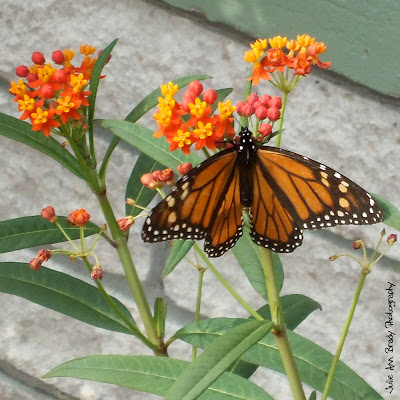
Monarch Butterfly on Tropical Milkweed
Monarch Butterfly on Tropical Milkweed November 8, 2017
This particular Monarch Butterfly arrived in my front yard garden in Leesburg, Florida on November 8, 2017. It made a beeline, so to speak, for my Tropical Milkweed, Asclepias curassavica, plant. "Other common names include bloodflower or blood flower, cotton bush, hierba de la cucaracha, Mexican butterfly weed, redhead, scarlet milkweed, and wild ipecacuanha." --Asclepias curassavica, Wikipedia

Monarch Butterfly on Tropical Milkweed
Monarch Butterfly on Tropical Milkweed November 8, 2017
Don't you wonder how the Monarch Butterfly knows there is a Tropical Milkweed plant in somebody's garden? Looking closely at this Monarch, I would say it is a female. I had previously seen Monarch Butterflies flitting through my front yard garden to check out the Mexican Petunias and Pentas.
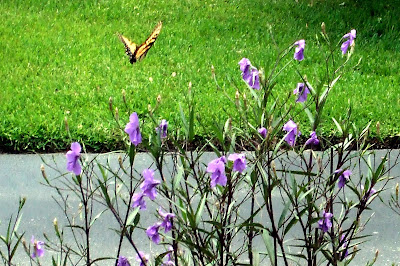
Monarch Butterfly on Mexican Petunias
Monarch Butterfly on Mexican Petunias August 4, 2017
Researching the butterfly friendly milkweed plant, Asclepias curassavica, I learned that there actually is a classification of butterflies known as the Milkweed Butterfly! I had to take a closer look at my photographs to see if the butterfly I observed and photographed was a true Monarch Butterfly.
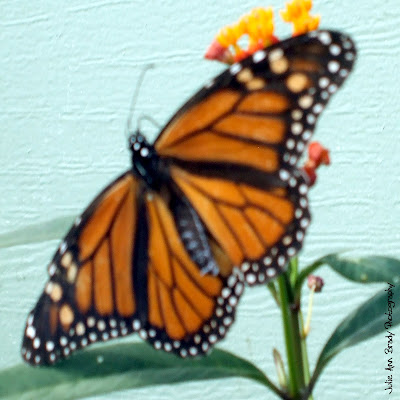
Monarch Butterfly on Tropical Milkweed
Monarch Butterfly on Tropical Milkweed November 8, 2017
"The monarch butterfly or simply monarch (Danaus plexippus) is a milkweed butterfly (subfamily Danainae) in the family Nymphalidae. Other common names depending on region include milkweed, common tiger, wanderer, and black veined brown." --Monarch Butterfly, Wikipedia
Something I have yet to observe is Monarch Butterflies mating! I do believe, without knowing it, I had seen a female Monarch laying an eggs on the Tropical Milkweed leaves.

Monarch Butterfly Caterpillar and Egg
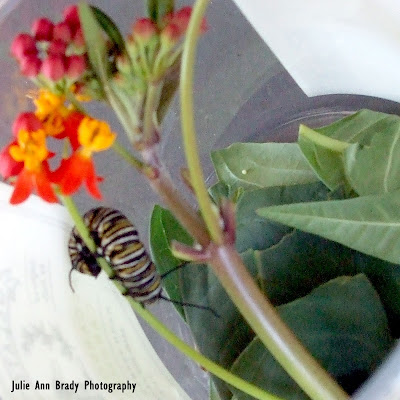

Monarch Butterfly Caterpillar and Egg on Tropical Milkweed
Monarch Butterfly Caterpillar on Tropical Milkweed March 7, 2018
It was the week of March 6th, 2018, when I began looking closely at my Tropical Milkweed plant to see if I could find any eggs or caterpillar. While I didn't see eggs or a caterpillar actually on the plant, I did happen to notice a Monarch Butterfly Caterpillar on the underside of my front step.

Monarch Butterfly Caterpillar and Egg on Tropical Milkweed
Monarch Butterfly Caterpillar and Egg on Tropical Milkweed March 7, 2018
When I saw the Monarch caterpillar, I first noticed a lot of little black ball-like particles on my front step. That was what made me look closer and then see the caterpillar emerging from under the step!

Monarch Butterfly Caterpillar and Egg on Tropical Milkweed
Monarch Butterfly Caterpillar and Egg on Tropical Milkweed March 7, 2018
It was because I spent some time at the Lake County Extension Center's Butterfly House in their Discovery Gardens that I knew I wanted to get the Monarch caterpillar to a safe place to complete its life cycle.

Monarch Butterfly Caterpillar and Egg on Tropical Milkweed
Monarch Butterfly Caterpillar and Egg on Tropical Milkweed March 7, 2018
I found a large jar in which I placed a couple of cuttings from the Asclepias curassavica species of Tropical Milkweed. I trimmed from the back of the plant and then trimmed the leaves from the base of the cutting. Upon photographing the caterpillar as it climbed the cutting, that was when I actually observed one small white egg on the leaf. See if you can spot the egg in the above photographs.

Monarch Butterfly Pupa or Chrysalis


Monarch Butterfly Pupa or Chrysalis on Tropical Milkweed
Monarch Butterfly Pupa or Chrysalis on Tropical Milkweed March 9, 2018
Checking on the Monarch Butterfly Caterpillar the next day, I saw it curled up sort of hidden amongst the leaf cuttings on the bottom of the jar. It was on March 9, 2018, that I actually saw a pupa or chrysalis!

Monarch Butterfly Pupa or Chrysalis on Tropical Milkweed
Monarch Butterfly Pupa or Chrysalis on Tropical Milkweed March 9, 2018
The Monarch Butterfly Pupa or Chrysalis had been attached high up on the Tropical Milkweed cutting, right below the flowers. Looking closely at the photos of March 9th, you can see a bit of black at the edge of the pupa. At first, I thought the caterpillar wasn't finished with the pupa.

Monarch Butterfly Pupa or Chrysalis on Tropical Milkweed
Monarch Butterfly Pupa or Chrysalis on Tropical Milkweed March 10, 2018
Checking on the Monarch Butterfly Pupa or Chrysalis on March 10th, as I lifted the limp Tropical Milkweed cutting, the black stuff fell off! Ah, poop perhaps? I had read where that caterpillar poops like crazy ... so I am surmising that it was the final poop left behind, as it became encased in the pupa for the next stage!

Monarch Butterfly Pupa or Chrysalis on Tropical Milkweed
Monarch Butterfly Pupa or Chrysalis on Tropical Milkweed March 10, 2018
It was on March 10, 2018, that I found a small, firm twig to attach the Tropical Milkweed cutting with the Monarch Butterfly Pupa to allow it to be suspended and hanging. Very carefully, with surgeon precision, I lifted the cutting and twisted it around the end of the twig. With some black electrical tape, I attached the cutting to the twig.

It is reported that a Monarch Butterfly emerges from the pupa or chrysalis state in two weeks time. I am hopeful that I will be reporting that before the end of March!

UPDATE MARCH 16, 2018


Late this Friday afternoon, I came outside to check on the Monarch pupa I had protected in a vented jar in the shed. Looking closely at the pupa, I saw almost a glittery look to the striping that ran the diameter of the pupa. Then, I noticed what appeared to be a small hole. It seemed I could see inside the pupa and it looked empty! I'm not sure what to make about that, but I will be taking a closer look at it tomorrow!

Monarch Butterfly Dead March 16, 2018
Next, I went to the front yard garden to check on the Tropical Milkweed plant to see perchance I might find a caterpillar crawling there or possibly another pupa. I didn't detect either of those, but looking down at the mulch near the plant I saw a dead Monarch Butterfly! This butterfly looks to be a smaller size from the butterfly shown up above as it was on the plant.

Monarch Butterfly Dead March 16, 2018
Oh no. I had been watching such a butterfly yesterday afternoon as it was busy on the plant. I wonder if it might be the same butterfly and what caused it to die? I've been seeing many wasps also on that plant and theorized maybe a wasp got it? Looking at its wings, I do see on the right side in the photo that there is a bit of damage. What could have caused that?

Monarch Butterfly Pupa Black
Monarch Butterfly Pupa Black March 27, 2018
Imagine my surprise when I found a content scraper had stolen my image of the Monarch Butterfly Black Pupa! Even more surprising was the fact that Google had indexed them and they were ranking fairly high in searches ... I saw their scraper website with MY IMAGE rather than seeing MY BLOG POST with my image! Snakes on the internet ... beware!!!

Monarch Butterfly Pupa Black

It is well past the 14 days in the pupa stage and now the chrysalis has turned dark black! Googling, I learned there is a condition known as "black death" or nuclear polyhedrosis virus (NPV).

Monarch Butterfly Pupa Black
Monarch Butterfly Pupa Black March 27, 2018
Researching NPV, you have to be careful about not infecting your caterpillar! In this case, it did appear that the Monarch butterfly caterpillar was not infected. So, knowing that the "black death" includes a foul odor, I will be sniffing out the black pupa and making sure there is no such odor or virus. Update: After watching that pupa for over a month, it seemed to be shriveling or drying up. No butterfly ever emerged.

Another Monarch Butterfly Caterpillar


Monarch Butterfly Caterpillar on Tropical Milkweed May 23, 2018
#2 Monarch Butterfly Caterpillar on Tropical Milkweed May 23, 2018
On May 23, 2018, I discovered another Monarch Butterfly Caterpillar on the Tropical Milkweed. I noticed that the flowering stem was broken and hanging there ... the caterpillar had eaten through the stem.

Monarch Butterfly Pupa on White Netting May 26, 2018
It was 9:15am on Saturday, May 26, 2018 as I checked on the caterpillar and found a small green pupa attached to the white netting cover! That was fast.
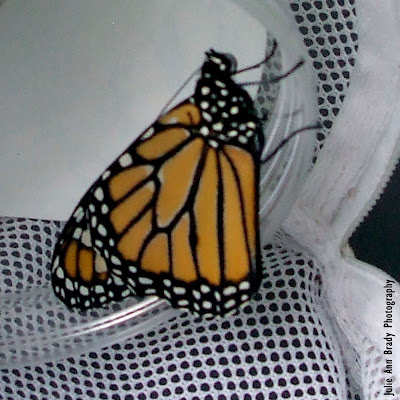
New Monarch Butterfly in 8 Days June 3, 2018
It was near 7am on Sunday, June 3, 2018 when I checked on the pupa to see a new Monarch Butterfly had emerged! That was 8 days after the caterpillar transformed into a pupa. Most impressive!

New Monarch Butterfly in 8 Days Drying Wings June 3, 2018
From the time I first discovered the new Monarch Butterfly, it was about 2.5 hours that it was drying its wings and then preparing for its first flight. It was interesting to see the orange transparent-like liquid dripping from the butterfly.

New Monarch Butterfly in 8 Days Flight Ready June 3, 2018
The very last photo I snapped of the new Monarch Butterfly, before it took flight, showed a slightly off-kilter butterfly. Once it took flight, it flew with a vengeance down my street, to the next street, and then off into the distance. About one hour later, I happened to see the new butterfly along with a bigger Monarch Butterfly in my front yard garden.

TWO MORE CATERPILLARS


June 6, 2018: I now have two more Monarch Butterfly caterpillars that I am nurturing! I just found a teeny little caterpillar quite by accident, after I pulled a large yellow leaf from the Milkweed plant. The caterpillar must have been on that leaf as I looked down at my left hand and saw what looked like a mealworm in the palm of my hand!

Monarch Butterfly Caterpillar on Tropical Milkweed Leaf June 6, 2018
#3 Monarch Butterfly Caterpillar on Tropical Milkweed Leaf June 6, 2018
It was seemingly overnight that the caterpillar started to look more recognizable! It was voracious in its appetite immediately upon rescue. That's the third MB caterpillar above.

Monarch Butterfly Caterpillar on Tropical Milkweed Leaf June 6, 2018
#4 Monarch Butterfly Caterpillar on Tropical Milkweed Leaf June 6, 2018
It has been a rainy morning on June 6, 2018. Coming out to the front yard garden to look over the Milkweed plant, it was quite by accident that I noticed this plumper MB caterpillar on a new growth of Milkweed underneath the burgundy penta plant.

#5 Monarch Butterfly Caterpillar on Tropical Milkweed Leaf June 6, 2018
It was early evening of June 6, 2018. I came out to my front yard garden to shoo a brown bunny away from the Russian Mammoth sunflowers. Walking by the Tropical Milkweed, my eyes stopped when I notice a Monarch Butterfly Caterpillar on the underside of a large leaf near the top of the plant. Bonanza on all the caterpillars lately!!

#5 Monarch Butterfly Caterpillar on Tropical Milkweed Leaf June 6, 2018
That makes 5 MB caterpillars that I've recently nurtured. At the moment, there are three MB caterpillars ... awaiting PUPA!!

UPDATE JUNE 8, 2008

Would you believe that the Monarch Butterfly Caterpillars [MBCs] are emerging like crazy? Six more MBCs are now being nurtured in a protected environment, awaiting pupa. It was 2 pm when I returned home from a movie and noticed 2 more MBCs on the Milkweed.

#10 Monarch Butterfly Caterpillar on Tropical Milkweed Seed Pod June 8, 2018
In the photo directly above, you can see the tenth MBC that is actually stretched out on a Tropical Milkweed seed pod. I opted to leave that caterpillar be and hope for the best. Within an hour, there was a downpour ... will check and see if the caterpillar is still hanging around.

#11 Monarch Butterfly Caterpillar on Tropical Milkweed Leaf June 8, 2018
In the photo directly above, you see a smallish MBC on a Tropical Milkweed leaf. I am leaving that one be as well and hoping for the best.

Checking on the nine that are in the protected environment, I observed another small MBC crawling on the netting cover ... it seemed a bit tinier than the one left on the Milkweed. Technically, that makes ten MBCs in the protected environment at the moment! And, it appears that one of those is actually relaxing before the pupa stage.

TWO MORE MONARCH BUTTERFLY CATERPILLARS


Two Monarch Butterfly Caterpillars on Tropical Milkweed June 8, 2018
It was the afternoon of June 8, 2018 that I happened to notice two pretty good-sized MBCs on the Tropical Milkweed. I am sure one of them is the MBC spotted earlier in the day, listed as #10 above.

Two Monarch Butterfly Caterpillars Eating Tropical Milkweed Seed Pod June 8, 2018
A little later in the afternoon of June 8, 2018, I saw two MBCs positioned on a seed pod with one on top and one on the bottom. It looked like they were head-butting each other as they were both pulling on the end of the seed pod to eat it. Very interesting to observe this activity! If you look closely, in the upper right background, you can see a teeny MBC.

INVASION OF THE MBC!

It seemed like maybe a week later and there was a massive invasion of the Monarch Butterfly Caterpillars! I mean, they literally took the Tropical Milkweed plant to the ground ... leaving it looking like a barren bamboo plant, the likes of something I had never seen. In this first invasion, there easily had to be 50 caterpillars if not more at one time munching on the plant!
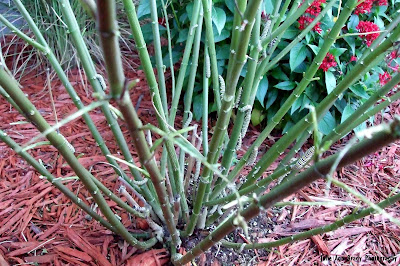
Last of the Monarch Butterfly Caterpillars on the Barren Tropical Milkweed
Last of the Monarch Butterfly Caterpillars on the Barren Tropical Milkweed June 15, 2018
June 15th and 16th were very active days for those MBCs! I had to watch where I was walking in the yard, carport and driveway as the caterpillars were on the roam! I even found a couple on the yellow Mandevilla plant!

Monarch Butterfly Pupa under Flower Box June 16, 2018
At the same time that I was finding all those pupa in and around the yard, there were several being nurtured in the shed. And, some new butterflies were emerging from the nurtured pupa!

3 New Monarch Butterflies and 2 Pupa and 1 MBC
3 New Monarch Butterflies and 2 Pupa and 1 MBC June 16, 2018
It was this first set of 3 new Monarch Butterflies which showed how tough Mother Nature could be. The one butterfly had a seriously deformed wing that was crumpled. I "worked" with that butterfly for a couple of days to nurture it and see that it could actually fly and be a happy butterfly. Those were some tough days!!

4 Monarch Butterfly Pupas under the Window A/C
4 Monarch Butterfly Pupas under the Window A/C June 17, 2018
By June 17th and 18th, I was noticing Monarch Butterfly Pupas in a variety of places. There were 4 under the window A/C, one under the window flowerbox, one under the side of the step to the Florida Room, one under the red chair, one attached to the overhead carport beam, 6 or more in the fountain grass.

New Monarch Butterfly on my Forearm
New Monarch Butterfly on my Forearm June 24, 2018
As each new Monarch Butterfly emerged, I was there to observe and be sure no predatory critter interfered. Despite all my good intentions, I still got to see quite a few Monarchs that either fell from their pupas, got stuck in their pupas, or couldn't get their wings to fully hang and dry.

Dead New Monarch Butterflies
Dead New Monarch Butterflies June 25, 2018
I saw three of the new Monarchs who had deformed wings, making them resemble more of a dragonfly. A new Monarch was found dead in the front yard garden missing its body! All in all, it was very tough to observe these beautiful creatures that had a failure to launch.

SECOND INVASION OF THE MBC!

It was maybe a week or so and I was recovering from that first invasion. I happened to be walking past the recovering Tropical Milkweed plant and stopped dead in my tracks. "Oh no!!! It's another invasion." I thought. Holy Smokes, but the plant just got back a few leaves and again it was covered with MBCs.

Monarch Butterfly Caterpillars on Tropical Milkweed
Monarch Butterfly Caterpillars on Tropical Milkweed July 5, 2018
I knew with this second invasion that I was going to try and stay detached from the whole process.
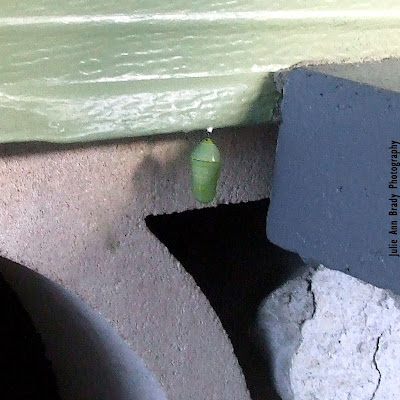
Monarch Butterfly Pupa by Step
Monarch Butterfly Pupa by Step July 9, 2018
By July 9th, I was finding a pupa here and there. I noticed two pupas in the fountain grass which was concerning as those previous new butterflies emerging from the fountain grass were having wing issues. Maybe only one half of those survived.

Thank you for stopping by my original and authentic blog post on the Monarch Butterfly. Please DO NOT STEAL my hard work ... including my copyrighted images and written content.